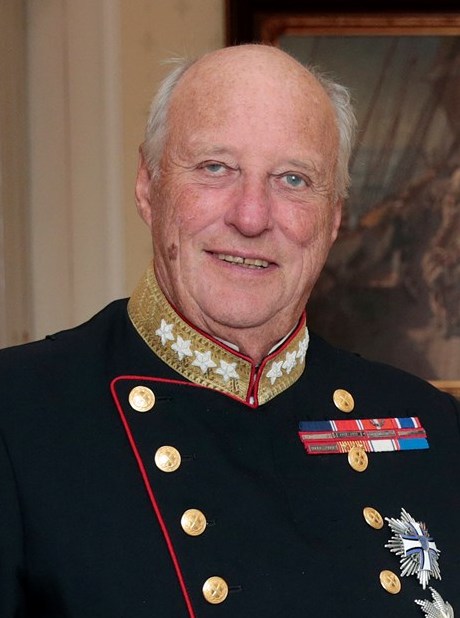
King Harald V of Norway, who as a boy fled the Nazi invasion of his homeland and grew up to spend 35 years modernizing one of Europe's oldest monarchies, died Friday at Oslo University Hospital. He was 89.
The royal court said Harald died shortly before dawn, at 6:35 a.m. local time, after more than a week in hospital. He had been admitted on Aug. 17 with haemolytic anaemia, a condition in which red blood cells break down faster than the body can replace them. His son, Crown Prince Haakon, automatically became king upon his father's death and will reign as King Haakon VIII.
Harald had been Europe's oldest reigning monarch. He ascended the throne on Jan. 21, 1991, following the death of his father, King Olav V, and adopted the motto "Alt for Norge" — All for Norway. Over 35 years he presided over a small constitutional monarchy that has little formal power but occupies an outsized place in Norwegian civic life, a role Harald leaned into by making the institution more visibly open, informal and accessible than his predecessors had.
A wartime childhood, a scandal, then a coronation
Harald's biography traced the arc of 20th-century Norway. Born in Oslo in 1937, he was the first Norwegian-born prince in more than five centuries. When German forces invaded in April 1940, the royal family fled the country; the young prince spent part of the war in exile before the family returned home after liberation in 1945.
As a young man he defied expectations by insisting on marrying Sonja Haraldsen, a commoner and his childhood sweetheart, rather than a foreign noblewoman. The relationship caused a public scandal that dragged on for nine years before his father relented; the couple married in 1968, and Sonja's evolution from commoner to widely respected queen became one of the more sympathetic threads of his reign. Away from the throne, Harald was also a serious competitive sailor, representing Norway at the 1964, 1968 and 1972 Olympics and later winning a world championship title in 1987, a pursuit that fed into his public image as an unpretentious head of state.
Harald's most quoted public moment came after the July 22, 2011 attacks, when a far-right extremist killed 77 people, most of them teenagers, in a bombing in Oslo and a mass shooting at a youth camp. Addressing a grieving nation days later, Harald declared, "I remain convinced that the belief in freedom is stronger than fear," a line that is still cited in Norway as a defining statement of national resilience. He was also known, later in his reign, for speeches embracing LGBTQ+ Norwegians and religious and ethnic minorities, statements that were read as deliberate departures from the more reserved posture of earlier Scandinavian monarchs.
Tributes from across Europe
Condolences arrived quickly from royal houses and governments across the continent. Sweden's King Carl XVI Gustaf said Harald had been "an outstanding representative of his country" both as head of state and as an athlete, while Denmark's King Frederik called him "an extraordinary man" who "joined duty and responsibility with presence and compassion." European Commission President Ursula von der Leyen said that "in moments of joy and sorrow, he brought Norwegians together," and French President Emmanuel Macron said Harald had "worked tirelessly throughout his reign to strengthen ties uniting Norway and France."
Under Norway's constitution, succession does not require a coronation or parliamentary ratification; Haakon's accession is automatic and takes effect immediately. The Norwegian royal household is expected to announce funeral arrangements and a formal period of mourning in the coming days, along with the protocol for Haakon's own transition into the role his father held for more than three decades.
Haakon, 52, has spent much of the past two decades taking on an increasing share of royal duties as his father's health declined in recent years, and has generally been viewed in Norway as a steady, low-drama heir attuned to the same informal style his father cultivated. He inherits a monarchy that remains broadly popular in national polling, though he now carries the responsibility of sustaining that support without the wartime and Cold War-era history that helped cement his father's standing. World leaders are expected to travel to Oslo for the funeral, which will likely be one of the largest gatherings of European royalty since the death of Britain's Queen Elizabeth II in 2022.