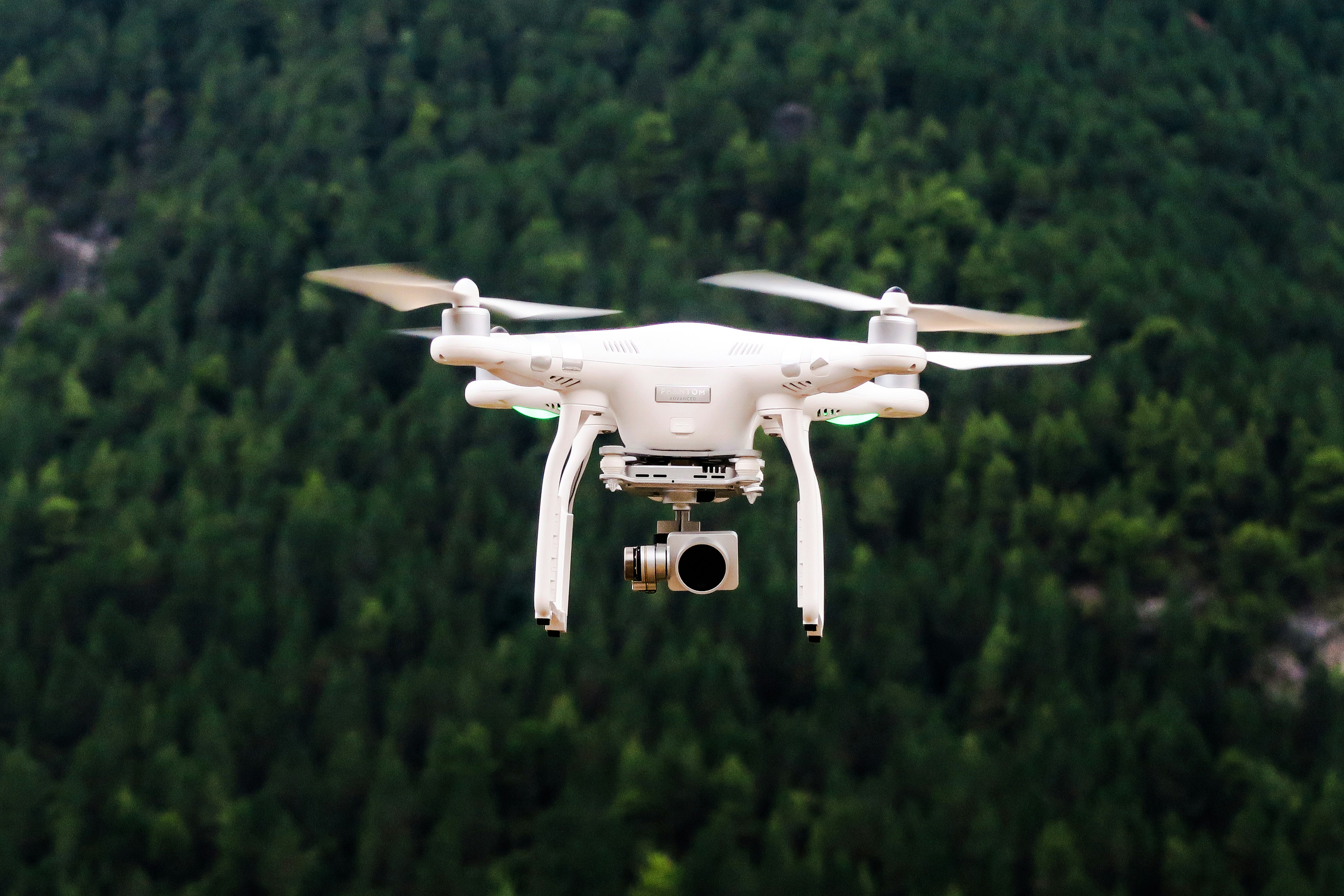
Amazon said this week that its Prime Air drone delivery service will expand to nearly 500 U.S. cities and towns by the end of 2026, a roughly sixfold jump from its current footprint that would turn a long-delayed experiment into one of the country's largest autonomous delivery networks.
The service, which today reaches 11 locations across seven states — including sites near Phoenix, Tampa, Kansas City and San Antonio — will add metro areas around Chicago, Atlanta, Cleveland, Syracuse and Boise in the coming months, according to Amazon's announcement. The company's newest aircraft, the MK30, can carry packages up to five pounds — Amazon says that covers roughly 60% of the items customers order most often — and deliver them in as fast as 30 minutes, with most orders arriving within an hour.
Pricing stays modest: Prime members get free drone delivery on orders of $50 or more, pay $2.99 below that threshold, and non-members pay $4.99. The drones, which Amazon says are electric and roughly as loud as an idling delivery truck during drop-off, operate under a Federal Aviation Administration Part 135 air-carrier certificate — the same regulatory tier that governs commercial cargo airlines, and the highest level of oversight the agency applies to drone operators.
A rocky runway to scale
Prime Air's path here has not been smooth. Amazon began outdoor deliveries in College Station, Texas, and Lockeford, California, in 2022, then spent years working through FAA approvals, noise complaints and technical setbacks before expanding beyond a handful of towns. Operations in Tolleson, Arizona were suspended after an MK30 collided with a crane in October 2025; Amazon has since resumed flights there. TechCrunch reports the company has now delivered hundreds of thousands of packages by drone this year, a volume that suggests the technology has moved from demonstration project to functioning, if still small, delivery channel.
Amazon isn't alone in the race. Walmart and Alphabet's Wing currently operate the largest rival drone-delivery network in the U.S. and recently expanded into Phoenix, Philadelphia and the Bay Area. DoorDash and Zipline have also been building out medical- and retail-delivery drone routes in smaller markets. The FAA's rules for package-delivery drones have loosened gradually over the past two years, allowing operators to fly beyond visual line of sight over populated areas — the single biggest technical and regulatory hurdle to scaling any of these networks past a few neighborhoods.
What the company is saying
Customers already turn to Amazon for fast Same- and Next-Day Delivery, and Prime Air provides them an even speedier option when they need it.
David Carbon, Vice President, Amazon Prime Air
Amazon frames the expansion as a natural extension of its logistics business rather than a novelty. The company says its Detect-and-Avoid system lets drones operate in light rain and a range of temperatures, and that the MK30 has double the range and half the noise of the model it replaces. Millions of items — groceries, electronics, cosmetics, medications and household goods — are eligible, priced the same as they would be through standard Amazon delivery.
Not every community has welcomed the drones. Noise and privacy complaints slowed early rollouts in College Station and Lockeford, and Tolleson's crane collision briefly reopened questions about how ready the technology is for dense, mixed-use airspace. Amazon has not detailed how it selected the newest five metro areas, or whether any of them raised objections during planning.
What happens next
Amazon's timeline calls for the full nearly-500-city footprint to be in place by the end of 2026 — an aggressive schedule that depends on continued FAA sign-off for new sites and on the MK30 fleet holding up at a scale several times larger than anything Prime Air has attempted before. If Amazon hits the target, drone delivery will have gone, in roughly four years, from a pair of pilot towns to a service within reach of a meaningful share of the U.S. population. Whether it can do so without another incident like Tolleson's may determine how quickly regulators let the next wave of expansion — beyond 500 cities — move forward in 2027.