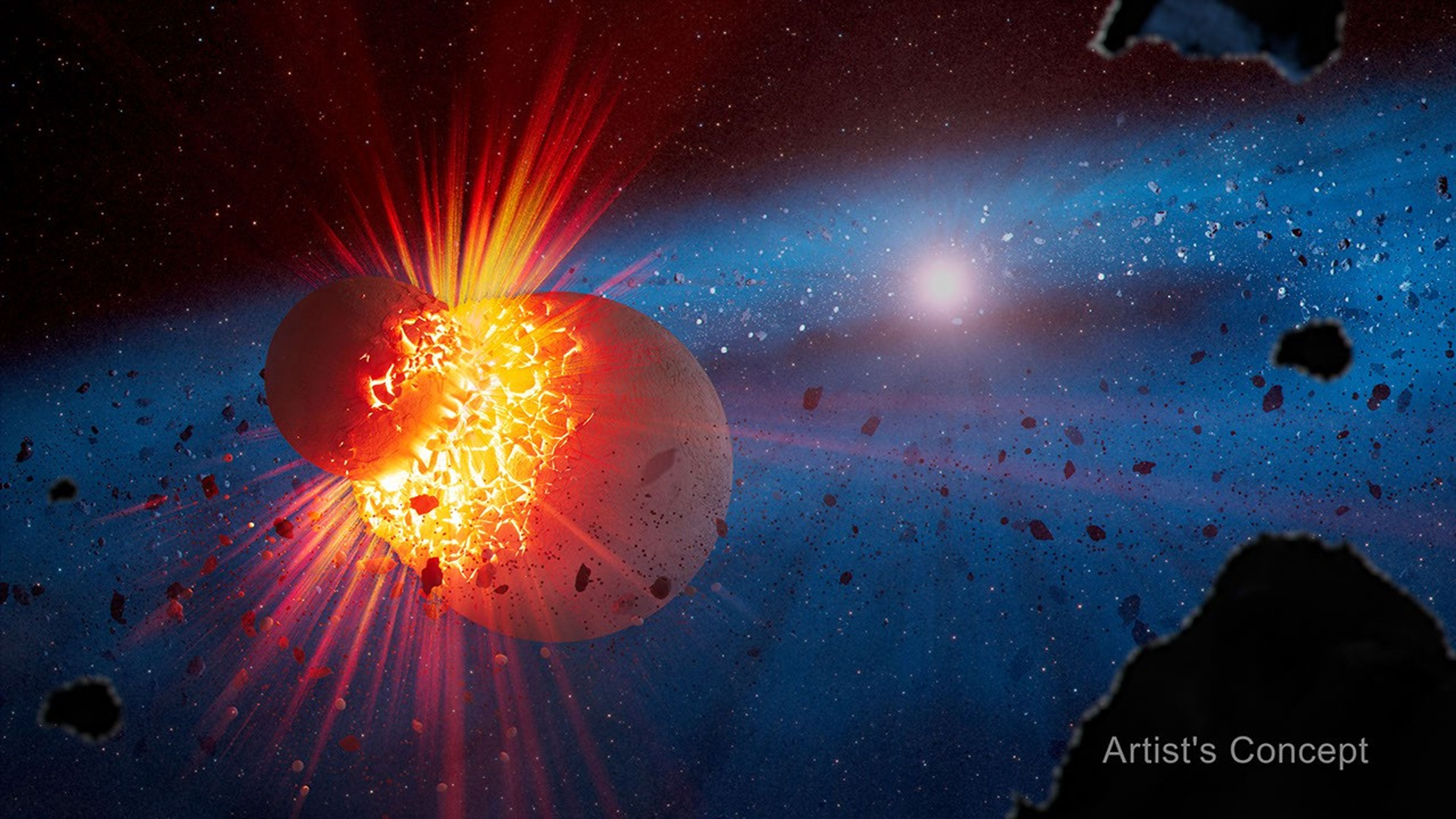
Astronomers using NASA's James Webb Space Telescope have assembled the largest-ever catalog of "extreme debris disks" — unusually dusty rings of debris around young stars — and found that their chemistry points to a violent process: head-on collisions between planetary building blocks as large as Mars.
The team, led by Kate Su of the Space Science Institute in Boulder, Colorado, examined 21 of these disks: 16 observed with Webb's Mid-Infrared Instrument, including 12 never studied before, plus archival data from NASA's retired Spitzer Space Telescope. The results were published Oct. 1 in The Astrophysical Journal.
About a third of the disks are rich in silica, a glassy material that forms when high-energy impacts vaporize rock — the signature, the researchers say, of collisions between Mars-sized protoplanets. The remaining two-thirds lack silica, consistent with gentler, grazing impacts between smaller, Moon-sized bodies. Silica-rich disks turned up only around stars younger than 300 million years, while the silica-poor kind persisted across a much wider range of ages, often varying unpredictably in brightness as fresh debris collides and resettles.
Extreme debris disks are rare: the team estimates only about 1% of young stars pass through a phase energetic enough to produce one, fewer than earlier theoretical work predicted. "This is the first time we have gathered enough systems to truly understand this subclass," Su said of the sample size, in comments released by NASA. Coauthor Agnes Kospal of Hungary's Konkoly Observatory said these disks are effectively the only way to study planetary embryos directly, since the objects themselves are too small and too far away to image.
The findings carry an echo closer to home. Scientists suspect Earth's own moon formed after a Mars-sized body, Theia, slammed into the infant Earth roughly 100 million years after the sun formed, vaporizing rock that later coalesced into the moon. Coauthor Attila Moor said the team expects no silica-rich systems among older extreme debris disks — a prediction based so far on just three aged disks in the sample, a small number the researchers themselves flag as needing more observations to confirm. The suggested link to the solar system's own early, chaotic bombardment period is described by the authors as "broadly consistent" with the data rather than proven.
NASA says the Webb observations, paired with the archival Spitzer data, will continue informing models of how rocky planets like Earth take shape — and how often, elsewhere in the galaxy, that process turns violent.