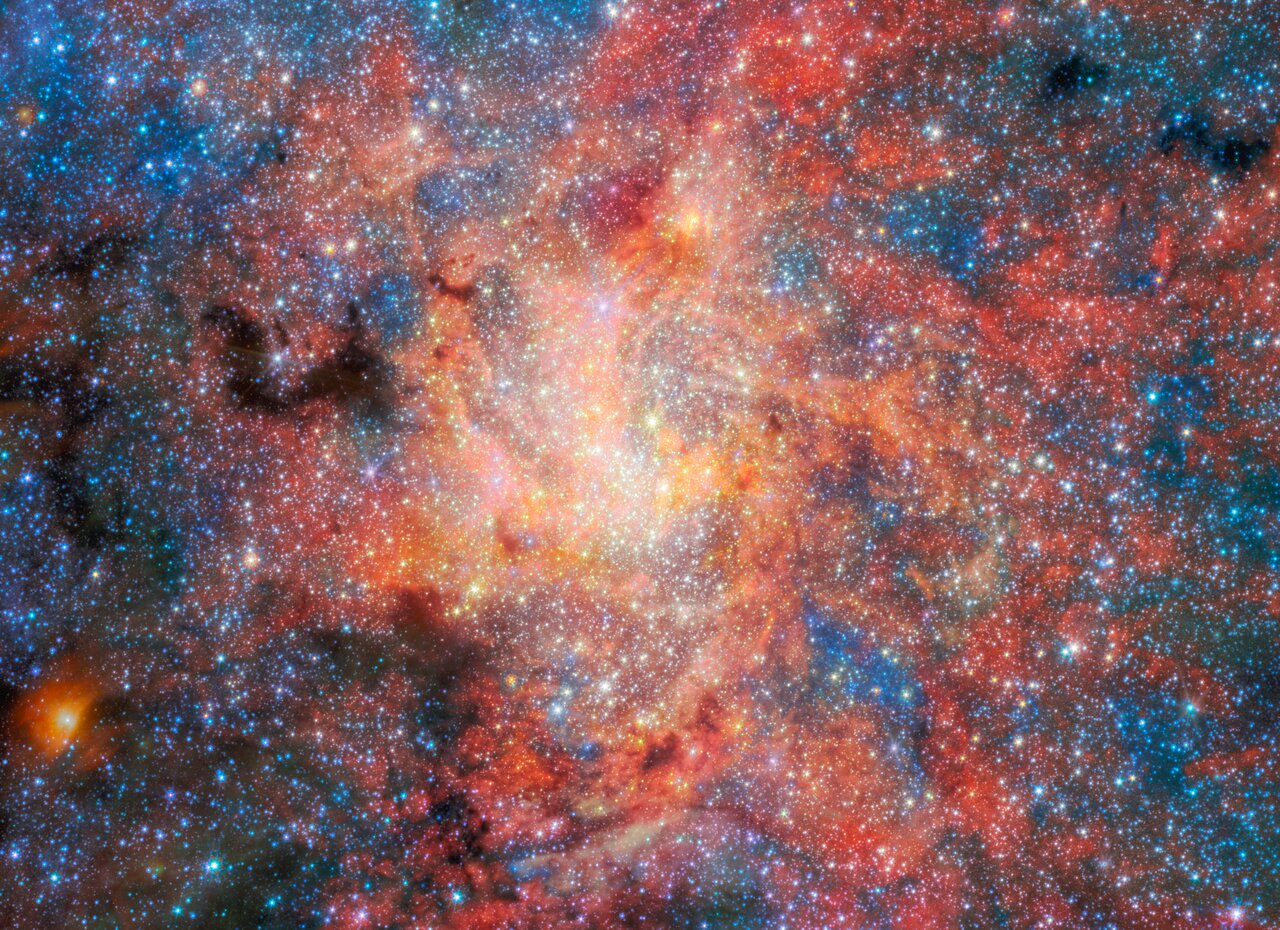
The James Webb Space Telescope has detected water and dust surviving in one of the most hostile patches of the galaxy: a stretch of space just 0.55 light-years from the supermassive black hole at the Milky Way's center. The finding, from an international team led by astronomer Florian Peißker of the University of Cologne, challenges assumptions that intense radiation near Sagittarius A* would strip away or prevent the formation of such fragile molecules.
Using Webb's Mid-Infrared Instrument, the team studied IRS 3, a dying star in the late "asymptotic giant branch" stage of its life, roughly six times the mass of the sun and about 72 million years old. The star is shedding a dust envelope that stretches across some 10,000 astronomical units, with temperatures ranging from a scorching 1,200 kelvin near the star's surface to a relatively mild 100 kelvin at the envelope's outer edge. Within that gradient, Webb's instruments picked up clear spectral signatures of oxygen-rich dust — and, for the first time in this environment, the fingerprint of water.
Rewriting assumptions about galactic centers
Astronomers had generally assumed the region around Sgr A* was too bathed in ultraviolet and X-ray radiation, and too disturbed by the black hole's gravity, for delicate dust grains or water molecules to condense and persist. IRS 3's survival suggests otherwise.
"Dust production remains remarkably resilient" this close to the black hole.
Florian Peißker, University of Cologne
Co-author Macarena Garcia Marin of the European Space Agency said the observations show that molecular material can survive in an environment dominated by intense radiation, hinting that evolved, dying stars may play a bigger role than expected in seeding galactic centers with the raw ingredients of dust and, potentially, future planetary systems.
The results, published Aug. 11 in Astronomy & Astrophysics, are part of Webb's MICONIC programme (Mid-Infrared Characterisation of Nearby Iconic galaxy Centres), which is systematically mapping the chemistry of the Milky Way's core. Researchers say follow-up observations of other evolved stars near Sgr A* could determine whether IRS 3 is an outlier or evidence of a broader, previously unrecognized cycle of material enrichment happening at the heart of the galaxy.