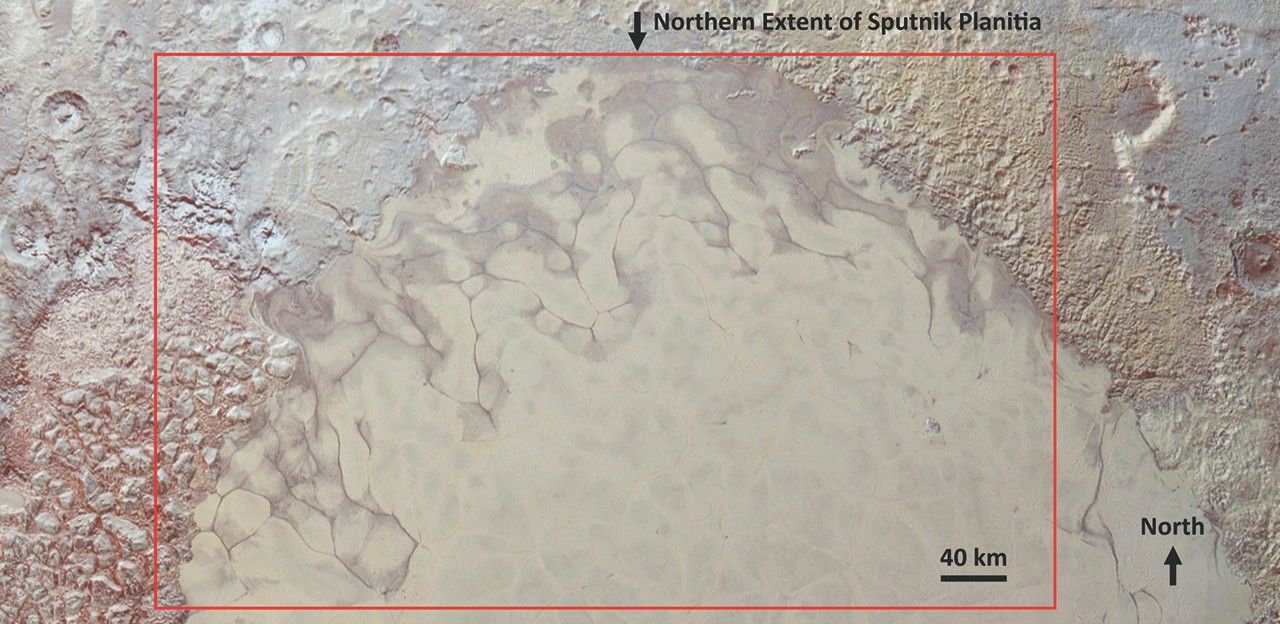
New analysis of decade-old spacecraft images suggests liquid nitrogen has recently risen to Pluto's surface through cracks at the northern edge of its famous heart-shaped glacier, the first evidence that liquid has flowed on the dwarf planet within relatively recent times. The finding, from a team led by the Southwest Research Institute, arrives as separate observations show Pluto's thin atmosphere beginning to shrink as the distant world drifts toward the darkest, coldest stretch of its 248-year orbit.
Cracks in a nitrogen glacier
The study, led by SwRI associate vice president and New Horizons principal investigator Alan Stern, re-examined 2015 flyby images of Sputnik Planitia, the nitrogen-ice plain that forms the left lobe of Pluto's Tombaugh Regio "heart" and covers an area larger than Texas and Oklahoma combined. Along the plain's northern edge, the team identified dark, narrow surface markings that closely resemble features seen on Earth's Greenland ice sheet, where dark streaks form as liquid water wells up through cracks and wets the snowpack below. Comparing the New Horizons imagery with Landsat 9 pictures of the Greenland ice sheet, the researchers concluded that the most plausible explanation is subsurface liquid nitrogen periodically rising and darkening Pluto's nitrogen ice from below.
"Pluto never stops surprising us," Stern said. "In addition to suggesting that liquids have recently expressed themselves on Pluto's surface, this result also suggests a new kind of time-variable feature on Pluto." The results were published in the Planetary Science Journal. Because nitrogen ice can turn to liquid at Pluto's surface temperatures under the right pressure and depth conditions, the team argues that pockets of liquid nitrogen beneath the glacier's crust, rather than exotic chemistry, best account for the markings.
A thinning atmosphere, decades in the making
The discovery lands alongside separate evidence that Pluto's wispy nitrogen atmosphere, sourced largely from ices like those in Sputnik Planitia, is starting to contract. Since its discovery in 1930, Pluto has never traveled farther from the sun than it is now heading; it will not reach the most distant point of its elliptical orbit until 2114. A decade-long survey of stellar occultations — brief dimmings of background stars as Pluto passes in front of them — found that atmospheric pressure held roughly steady from the 2015 New Horizons flyby through mid-2021, then dropped by about 16 percent by July 2023, a signal that Pluto's atmosphere may be starting to freeze back onto the surface as sunlight and surface temperatures fade.
Scientists caution the atmosphere is unlikely to vanish outright: the vast nitrogen ice reservoir in Sputnik Planitia should keep replenishing at least a trace atmosphere for decades to come. Taken together, the two findings paint Pluto as a world still geologically and atmospherically active rather than a frozen, static relic — one where nitrogen continues to cycle between ice, liquid pockets and a slowly waning envelope of gas even five billion miles from the sun.