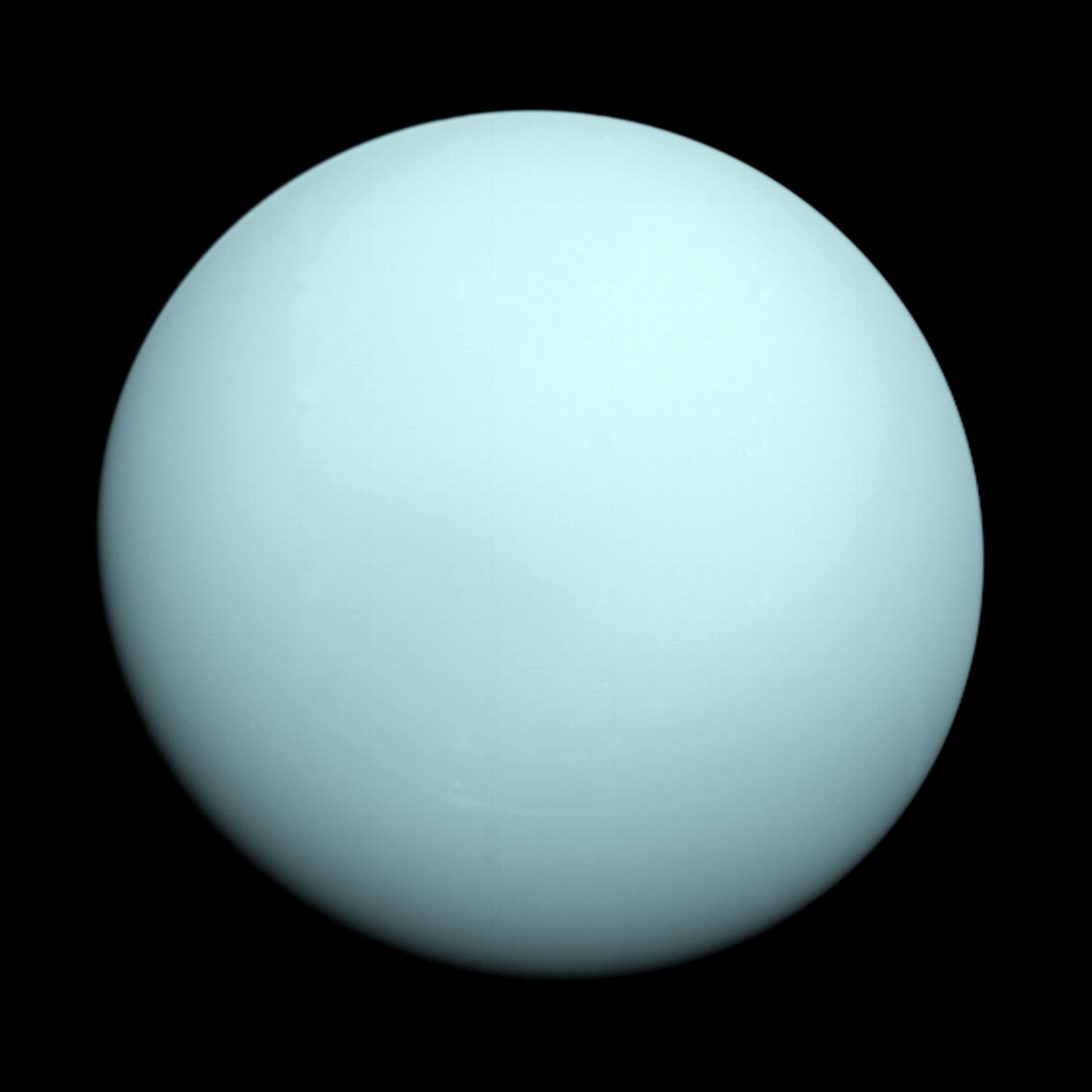
When NASA's Voyager 2 spacecraft flew past Uranus and Neptune in the 1980s, it found something nobody expected: magnetic fields tilted so far off-kilter that they barely resemble the tidy bar-magnet geometry of Earth's own field. Earth's magnetic axis is tilted about 11 degrees from its spin axis. Uranus's is tilted 59 degrees; Neptune's, 47. For four decades, nobody could fully explain why.
A new study led by Chi Yan, a research associate at the University of Texas at Austin's Institute for Geophysics, working with researchers at UCLA, Imperial College London and Northumbria University, proposes an answer: deep inside the two ice giants, pressure and heat may be intense enough to rip water molecules apart into electrically charged ions, making the surrounding material increasingly conductive the deeper it sits. Published in the journal Communications Physics, the team's computer simulations modeled how that depth-varying conductivity would shape a planetary dynamo — the churning, electrically conductive fluid that generates a magnetic field in the first place.
A Magnetic Field That Might Not Sit Still
"Deep inside Uranus and Neptune, pressures and temperatures become extremely high," Yan said. "Under these conditions, which can cause water molecules to break apart into ions, the material may become increasingly electrically conductive with depth." When the researchers built that assumption into their models and let them run, the simulations reproduced the kind of lopsided, multi-pole fields Voyager 2 actually recorded.
The more surprising result was about time. Earth's magnetic tilt creeps by roughly a degree every 50 years. Yan's models suggest Uranus and Neptune could behave nothing like that — in some simulated stretches, the tilt swung by tens of degrees within a few decades. "Our models show the ice giants can behave very differently," Yan said. "In some stretches the tilt swings by tens of degrees within decades. In others it shifts only slightly over the same span."
If the models are right, the magnetic fields now surrounding Uranus and Neptune could already look meaningfully different from the ones Voyager 2 charted during its brief flybys — and outside astronomers note that the James Webb Space Telescope, which has already captured auroral and atmospheric activity on both planets, is one of the only instruments capable of testing that prediction without sending another spacecraft. No orbiter has visited either ice giant since Voyager 2's two flybys, and none is currently funded to go.