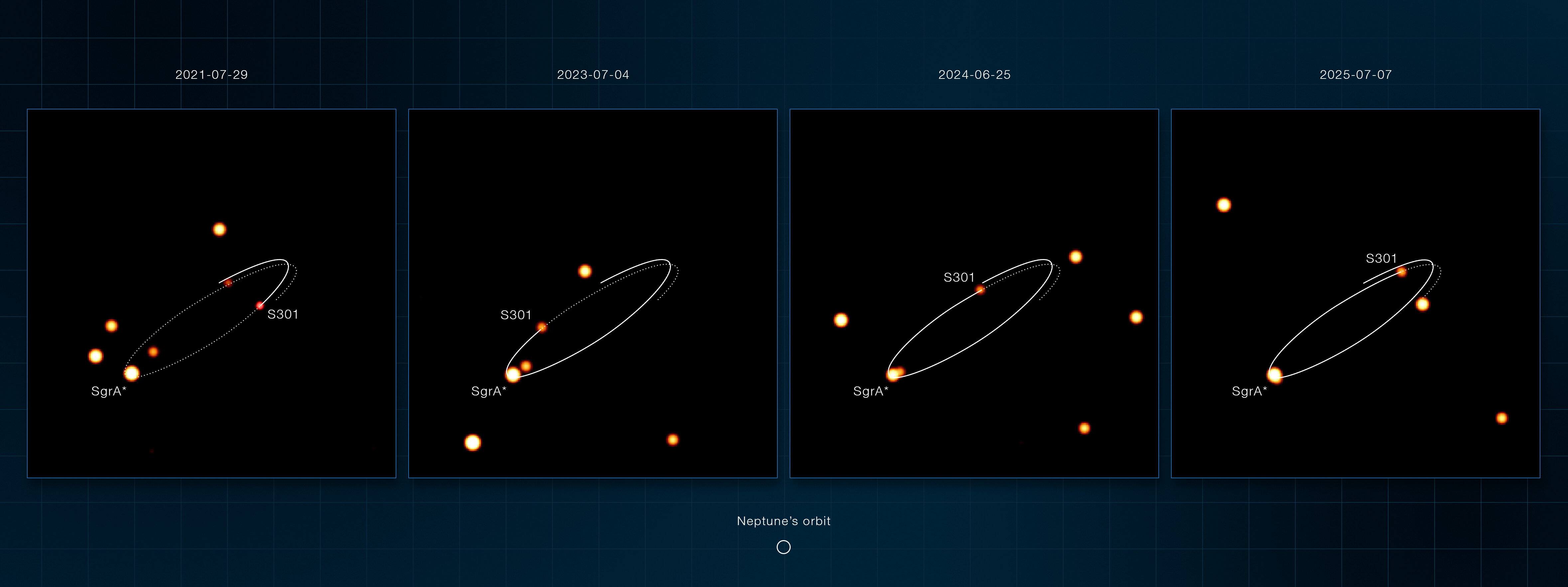
Astronomers have found a star skimming closer to the Milky Way's central black hole than any object ever observed, a discovery that could give physicists their first direct measurement of how fast a supermassive black hole spins.
The star, cataloged as S301, was spotted using the GRAVITY+ instrument on the European Southern Observatory's Very Large Telescope Interferometer in Chile. It completes one orbit around Sagittarius A*, the roughly four-million-solar-mass black hole at the galaxy's center, in just 8.7 years — at its closest approach passing within about 1.78 billion kilometers, only slightly farther than Saturn is from the sun. At that point it reaches speeds near 25,000 kilometers per second, more than 8 percent of the speed of light, making it the fastest star yet documented in the Milky Way.
Why proximity matters
The find, published in the journal Nature, matters less for the speed record than for what S301's tight orbit makes possible. General relativity predicts that a spinning black hole drags the fabric of spacetime around with it, a phenomenon called the Lense-Thirring effect. Detecting that drag requires a test object orbiting close enough to feel it — and no star tracked around Sagittarius A* has come this near before. Researchers say that by charting how S301's orbit twists over repeated passes, they could measure the black hole's spin directly for the first time, rather than inferring it indirectly from surrounding gas or radiation.
With this star we hope to measure, within the next 10 years, the spin of the black hole.
Felix Mang, PhD student, Max Planck Institute for Extraterrestrial Physics
Colleague Stefan Gillessen, also of the Max Planck Institute, described the prospect similarly in the ESO release: for the first time, astronomers would be able to directly measure the spin of a massive black hole rather than estimate it. That distinction matters because a black hole's spin, along with its mass, is one of only two properties needed to fully describe it under general relativity — yet spin has been far harder to pin down than mass for any black hole, including our galaxy's own.
A measurement still years away
The discovery itself does not yet tell astronomers how fast Sagittarius A* is spinning. Confirming the Lense-Thirring effect requires observing at least two complete orbits of S301, and the star's next close approach isn't expected until 2031. Until then, the finding stands as a discovery and a roadmap rather than a finished measurement — as several outlets covering the paper have noted, the payoff depends on years of additional monitoring with the VLTI and its successors.
Astronomers have tracked stars orbiting Sagittarius A* for decades — most famously S2, whose orbit helped confirm the black hole's mass and, in 2020, helped win a Nobel Prize for the scientists who charted it. S301 orbits far closer than S2 ever does, which is precisely what makes the new spin measurement conceivable. The result adds one more data point to a broader effort, spanning gravitational-wave detectors and the Event Horizon Telescope, to test whether black holes across the universe behave exactly as Einstein's century-old equations predict.