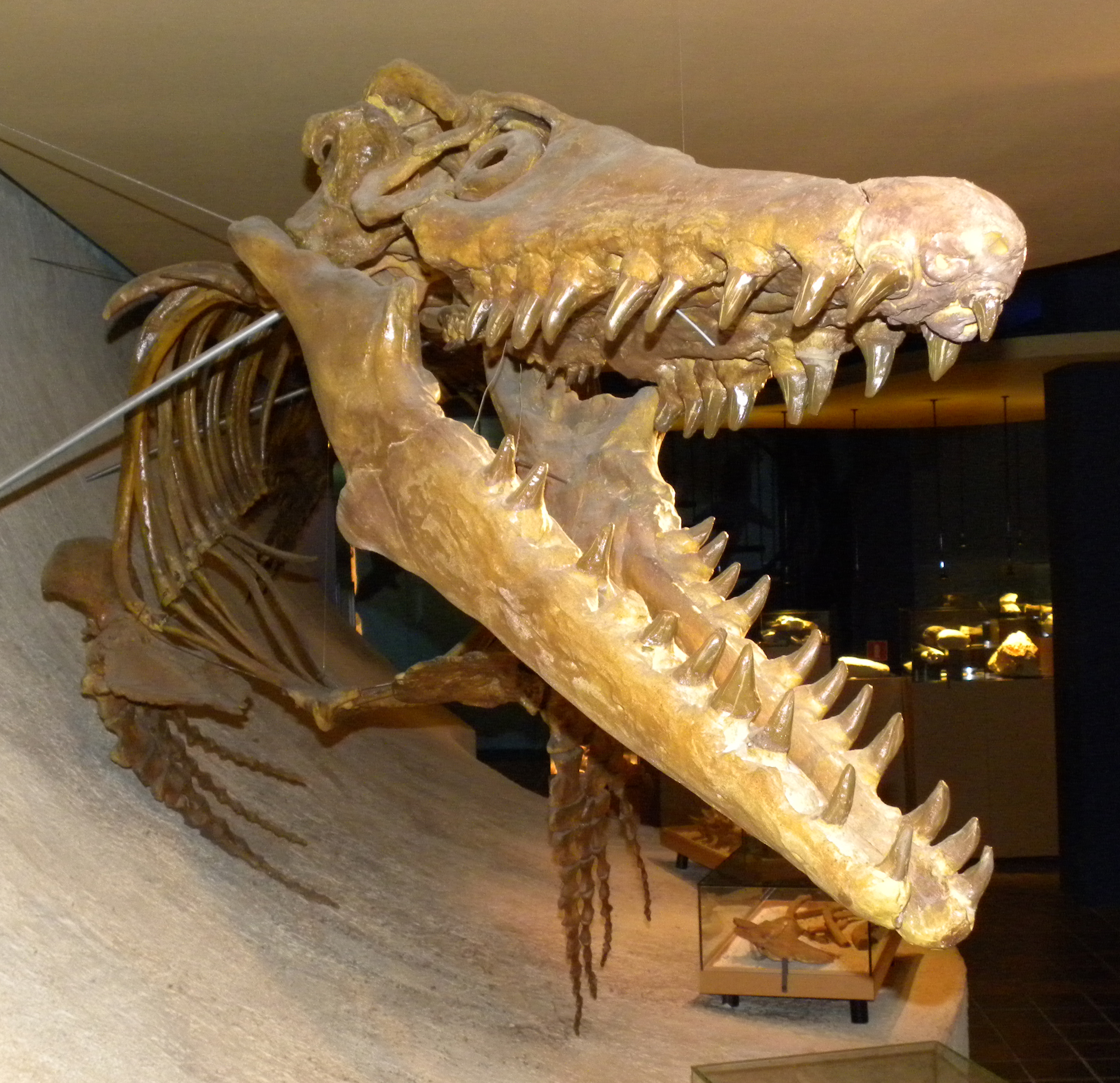
A fossil block collected more than three decades ago in Osaka Prefecture has yielded four previously unrecognized bones from a giant Cretaceous marine reptile, including the first confirmed mosasaur premaxilla, the frontmost bone of the upper jaw, ever identified in Japan, researchers announced.
The specimen was excavated between 1990 and 1992 in Sobura, in the city of Kaizuka, and has been housed at the Natural History Museum, Kishiwada City ever since. A team from Okayama University of Science and Tokyo City University re-examined the rock and found that portions of the skull embedded inside it had gone unrecognized for roughly 30 years.
Mosasaurs were large, air-breathing marine lizards that patrolled oceans worldwide during the Late Cretaceous, roughly 98 million to 66 million years ago, before going extinct alongside the dinosaurs. Fossils of the group are relatively rare in Japan compared with North America and Europe, making any well-preserved cranial material valuable for reconstructing how the animals evolved and dispersed across the Pacific.
Unusual anatomy
Beyond the premaxilla, the team identified distinctive features in the basisphenoid, a bone located near the base of the braincase: short, horn-like projections extending outward from its sides, and the absence of a groove that runs along the underside of the bone in previously described mosasaurs. Those anatomical quirks do not match any known species, researchers said, raising the possibility that the Osaka specimen belongs to an entirely new mosasaur lineage, though confirming that will require additional preparation and comparison with related fossils.
The findings were presented at the 177th Annual Meeting of the Palaeontological Society of Japan, held June 27 at Osaka Metropolitan University. The research team included graduate student Yasuaki Takano, associate professor Shoji Hayashi of Okayama University of Science's paleontology program, and Tokyo City University professor Yasuhisa Nakajima, along with curators from the Kishiwada museum.
The discovery underscores how museum drawers can hold overlooked scientific material for decades. Researchers say the specimen will undergo further mechanical preparation to expose additional bone surfaces still buried in rock, work that could eventually support a formal species description and name.
Mosasaur fossils recovered from Japan and the surrounding northwestern Pacific remain scarce compared with the abundant finds along the former Western Interior Seaway of North America, so each additional skull element helps paleontologists map how the predators spread and diversified across ancient ocean basins. A confirmed new species from Osaka would add to a small but growing list of mosasaurs described from East Asia in the past decade.