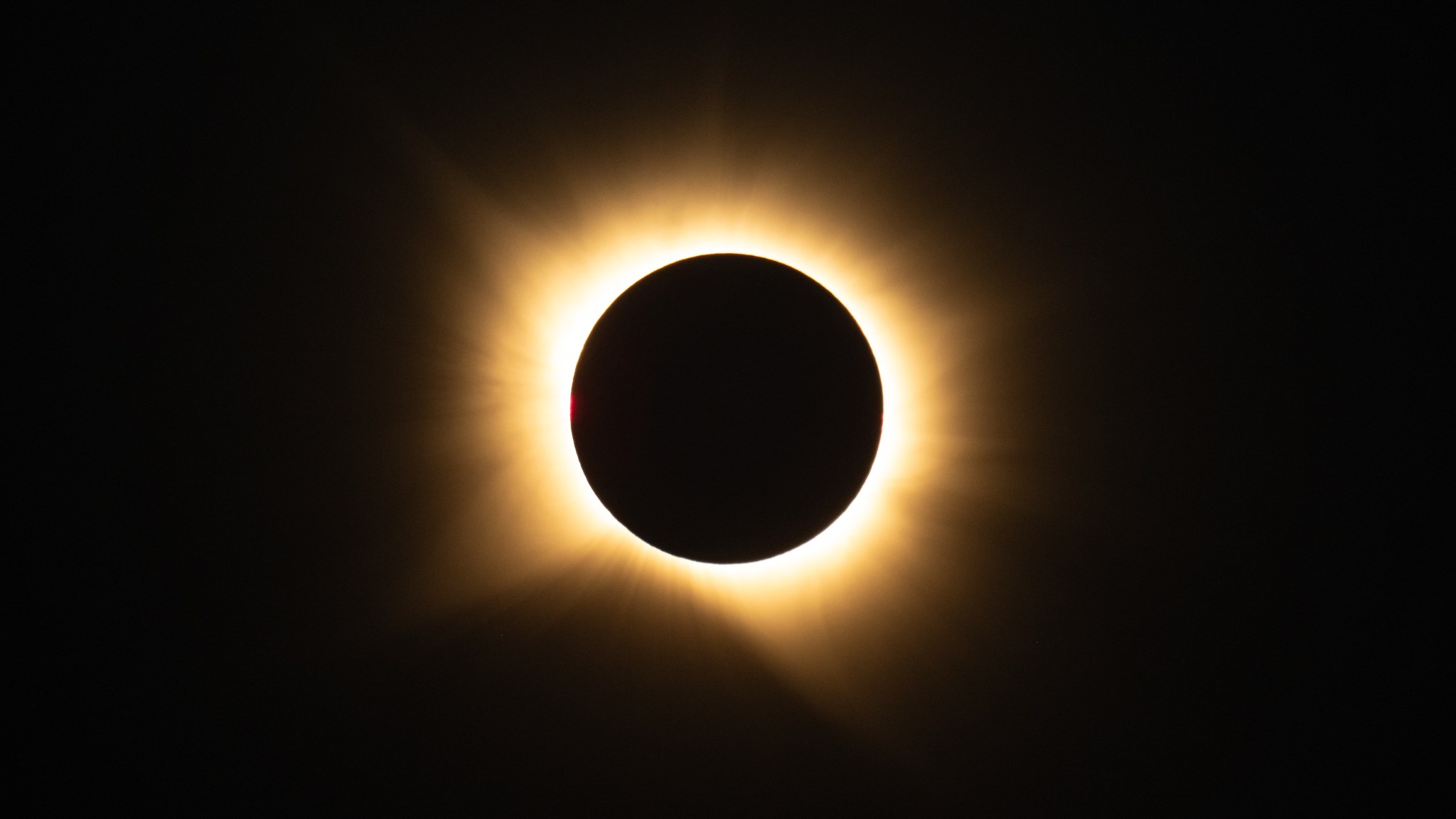
On Wednesday, the Moon's shadow swept across the North Atlantic, plunging parts of Greenland, Iceland, northern Russia, Spain and Portugal into a rare midday darkness during a total solar eclipse. It was Spain's first total eclipse since 1905, according to NASA, and one of the most widely watched sky events of the year, with the path of totality barely 294 kilometers wide at its broadest point.
For most observers, the Moon fully blocked the Sun for under two minutes; near the path's center, over Greenland and the North Atlantic, totality stretched to nearly two and a half minutes. In Spain and Portugal the eclipse arrived low in the sky, in the hour before sunset, casting the Sun's pale corona over cathedrals, rivers and hillsides already tinted orange by the evening light.
The brief window of totality is more than a spectacle. With the Sun's blinding disk blocked, its faint outer atmosphere, the corona, becomes visible to the naked eye, offering scientists a rare chance to study why that layer runs millions of degrees hotter than the surface beneath it, a longstanding puzzle in solar physics.
Chasing the shadow
NASA-funded teams did not simply watch from the ground. A high-altitude research jet fitted with four cameras in its nose cone tracked the Moon's shadow across the sky, extending useful observing time well beyond what any fixed location could offer. Separately, researchers launched roughly 80 scientific balloons in Iceland and six more in Spain, carrying instruments to measure how the sudden plunge into darkness and cold affects the upper atmosphere.
Volunteers played a role too. Teams from the NASA-backed Dynamic Eclipse Broadcast Initiative set up roughly 150 kilometers apart in Leon and the Castilian village of Valoria la Buena to image the corona and relay live video, while the European Space Agency streamed the event from the Javalambre Observatory, blending telescope feeds, drone footage and expert commentary. Ordinary skywatchers were asked to log wildlife behavior, temperature swings and cloud cover as the shadow passed overhead.
The next eclipse on the calendar is less dramatic but still notable: a partial lunar eclipse on August 27-28, visible across much of North and South America.