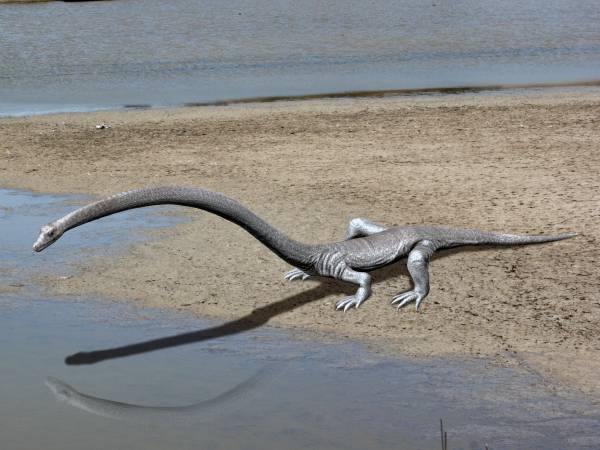
Paleontologists in China have described a 244-million-year-old marine reptile fossil so well preserved that its stomach, liver and intestines survive as faint, ghostly outlines in the surrounding rock. The animal, a diminutive tanysaur named Austronaga minuta, offers what researchers call the oldest largely complete digestive system ever recovered from a reptile, according to a study published in Science Advances.
The fossil, only about 60 centimeters (two feet) long despite an unusually long neck and tail, was recovered from Middle Triassic rock that once sat at the bottom of the Tethys Ocean. Under ordinary light the soft tissue is invisible, but researchers photographed the slab under ultraviolet illumination, which made the decayed organs fluoresce faintly against the surrounding stone. The liver showed a reddish tint the team attributes to iron-rich compounds left behind by degraded blood, while the stomach appeared as a single large, sac-like chamber.
From simple gut to two-chambered stomach
That single chamber is the finding paleontologists say matters most. Birds and crocodiles — living descendants of the archosaur lineage Austronaga belonged to — evolved two-part, muscular stomachs adapted to grinding tough food. Austronaga's simpler, single-chambered gut, paired with a short intestinal tract resembling that of modern fish-eating monitor lizards, suggests archosaur digestive systems started out anatomically basic and only became more specialized tens of millions of years later.
The digestive system of Austronaga minuta was relatively simple in structure. This fossil is the oldest known example of a largely complete digestive system in a reptile.
— Wei Wang, Institute of Vertebrate Paleontology and Paleoanthropology, Chinese Academy of Sciences
The species name translates roughly to "small southern naga," referencing both its size and its serpentine build, evoking the long-bodied naga of South and Southeast Asian mythology. Co-author Nick Fraser of National Museums Scotland noted that soft-tissue preservation this detailed is exceptionally rare in reptile fossils of any age, since organs typically decompose long before fossilization can occur.
The find adds to a small but growing catalog of Triassic marine reptiles — a group that also includes the long-necked tanystropheids and the dolphin-like ichthyosaurs — that diversified after the mass extinction at the end of the Permian period roughly 252 million years ago. Researchers say further ultraviolet imaging of fossils from the same Chinese formation could reveal whether other early archosaur relatives shared Austronaga's simple gut, helping trace when and why the more complex two-chambered stomach evolved.