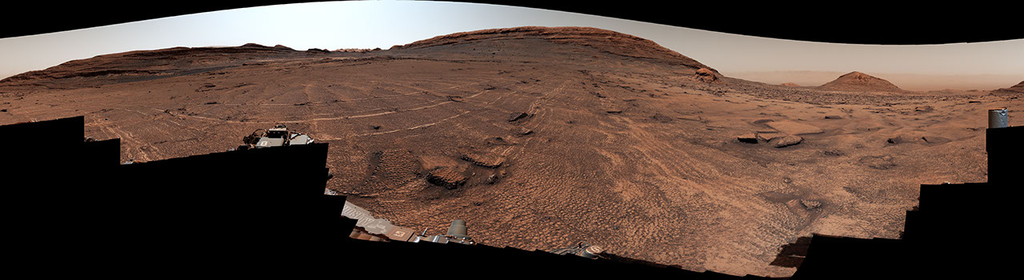
NASA's Curiosity rover has photographed the largest field of honeycomb-shaped ground cracks it has ever seen on Mars, a sprawling expanse of small polygons that stretches to the horizon in every direction inside a valley the mission team has nicknamed "Valle Grande." The discovery was announced by NASA's Jet Propulsion Laboratory, which manages the mission.
The individual fractures measure roughly 2 to 4 inches (5 to 10 centimeters) across, and Curiosity has spotted similar polygon patterns in small patches before, but never at this scale. The rover captured the scene in a 360-degree panorama, stitched together from 340 individual images taken over two Martian days — sols 4,930 and 4,931 of the mission, corresponding to June 19 and 20 on Earth. The polygons even wrap around the base of a nearby 20-foot sand-capped butte the team has named "Miraflores."
"We've seen a lot of fascinating landscapes through Curiosity's eyes, but this sea of polygons took our breath away," said Ashwin Vasavada, the mission's project scientist at JPL.
Cracks with a story to tell
Scientists have not settled on how the pattern formed. Candidate explanations include mud drying and cracking at the surface, repeated cycles of warming and cooling that fractured the ground over time, or compaction that squeezed water out of buried sediment as it was compressed under later layers of rock. Similar polygonal fracture networks on Earth typically form in one of these ways, but distinguishing among them on Mars requires more data than the rover has yet collected.
The find matters because Curiosity's central task, in its 14th year on Mars since landing on August 5, 2012, is reconstructing how the planet shifted from a world with liquid water, organic chemistry and conditions that could plausibly have supported microbial life to the cold, dry desert seen today. Fracture networks like the one in Valle Grande can preserve a record of exactly when and how water left the rock, complementing earlier Curiosity findings of ancient lakebeds and organic molecules on the slopes of Mount Sharp, the mission's long-term climbing target.
Independent science outlets covering the release, including ScienceDaily, noted that the sheer size of the polygon field is itself new information, since prior detections were limited to scattered small patches rather than a continuous surface. Mission scientists plan to use Curiosity's instruments on future drives through the valley to sample the chemistry of the fractured rock directly, which should help narrow down which of the competing formation theories best explains what the rover is seeing.