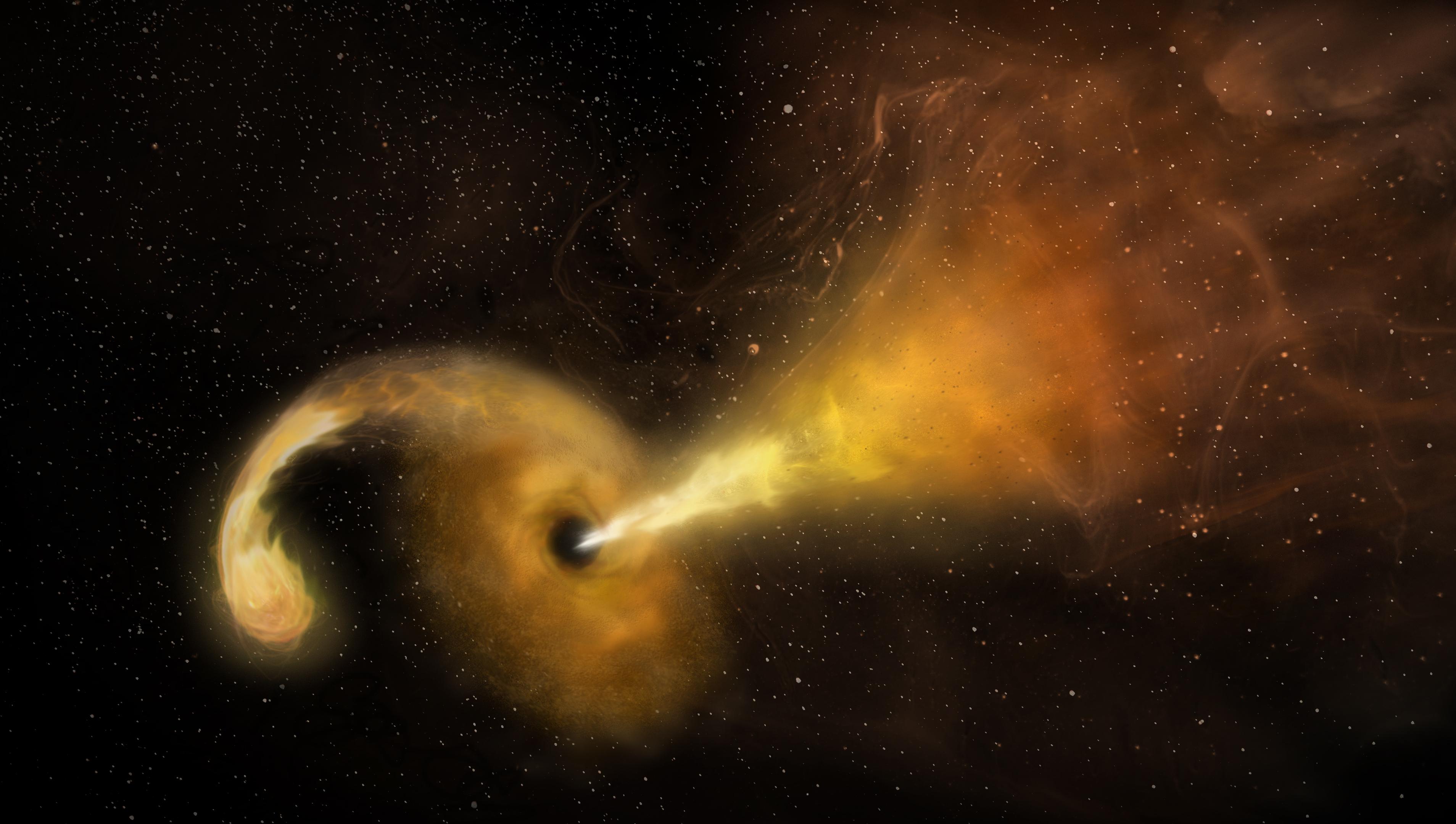
Astronomers have published a detailed analysis of one of the most luminous stellar explosions ever recorded, an eruption triggered when a supermassive black hole tore apart a massive star hundreds of millions of light-years away. The event, catalogued as AT2024wpp and nicknamed "the Whippet" for how quickly it flared and faded, released more energy than any known supernova, according to a study in the Monthly Notices of the Royal Astronomical Society.
At its peak, the blast radiated energy equivalent to roughly 400 billion suns, exceeding the brightest known supernovae, according to the study led by astronomer Daniel Perley of Liverpool John Moores University. A shockwave from the disrupted star plowed outward through dense surrounding gas at about one-fifth the speed of light, and spectra showed helium racing away from the blast at more than 6,000 kilometers per second. After roughly half a year of extreme brightness, the transient abruptly fizzled out, fading far faster than a typical supernova would.
A rare class of transient
The eruption was first flagged by Anna Ho, an astronomer at Cornell University, using the Zwicky Transient Facility at Palomar Observatory in California, which scans the sky nightly for objects that brighten or fade suddenly. Follow-up observations came from the Liverpool Telescope in the Canary Islands, NASA's Swift satellite, and the Keck, Magellan and Very Large Telescope observatories. Together they placed the Whippet in a rare category known as fast blue optical transients, sometimes called "Cow-like" events after the prototype eruption AT2018cow, of which only a handful have ever been documented.
Unlike ordinary tidal disruption events, in which a star is gradually stretched and swallowed by a black hole's gravity over weeks, fast blue optical transients brighten and decay within days, complicating efforts to pin down what is powering them. The leading explanation for the Whippet is that debris from the shredded star fell rapidly onto the black hole, launching a burst of radiation before the newly formed accretion disk dissipated.
The findings were presented at the American Astronomical Society's January meeting in Phoenix and have drawn attention because the object's energy output challenges existing models of how black holes accrete stellar debris. Researchers say the case strengthens the argument that at least some fast blue transients originate from black holes consuming massive stars rather than from the deaths of massive stars alone.
With wide-field survey instruments including the Vera C. Rubin Observatory now coming online, astronomers expect to catch more of these fleeting events in the years ahead, potentially resolving the debate over what powers them before they vanish.