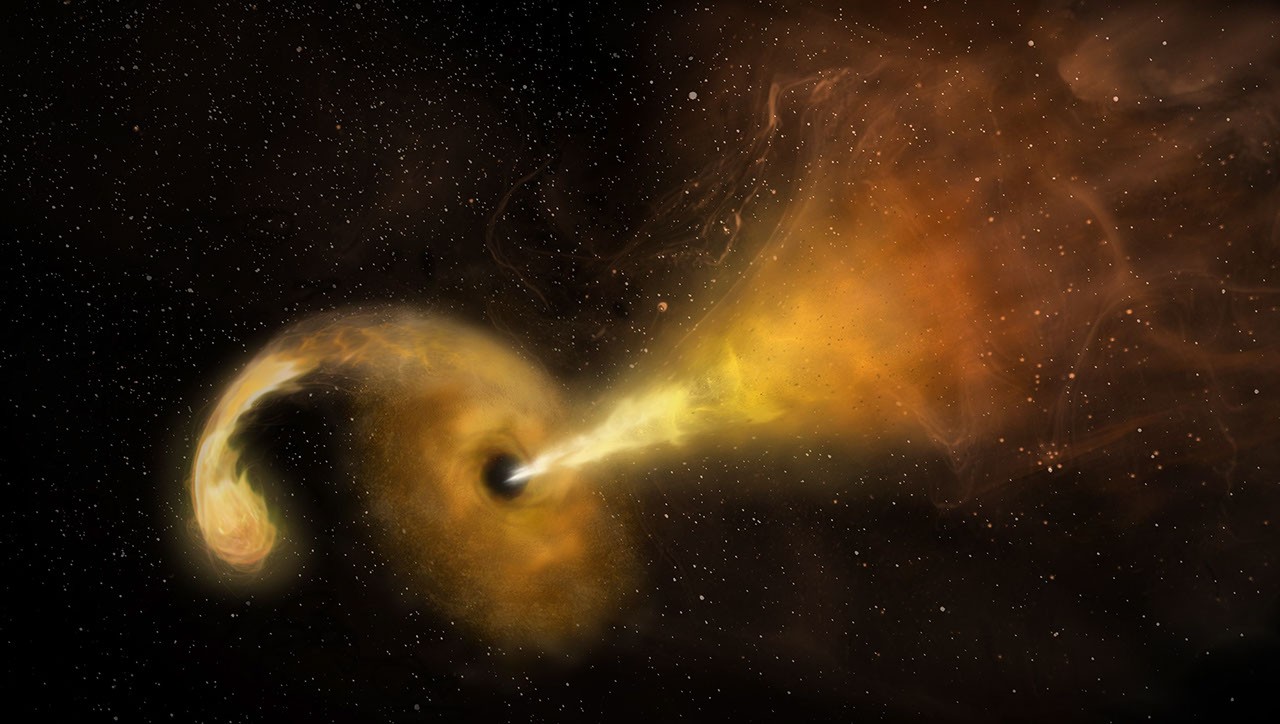
Astronomers have caught a supermassive black hole in the act of feeding on a star far from where any black hole is supposed to live: roughly 30,000 light-years from the center of its host galaxy, rather than anchored at its heart. The event, cataloged as TDE 2025abcr, is the farthest offset ever recorded for a tidal disruption event found in visible light, and it offers rare direct evidence that massive black holes can end up wandering the outskirts of galaxies after cosmic collisions.
A tidal disruption event happens when a star strays too close to a black hole and is ripped apart by the black hole's gravity, its shredded gas swirling inward and briefly blazing bright enough to outshine the entire galaxy around it. In this case, researchers led by Igor Andreoni's team at the University of North Carolina at Chapel Hill spotted the flare in a galaxy known as WISEA J014656.04-152214.7, about 750 million light-years away in the constellation Cetus, using the Zwicky Transient Facility survey at Palomar Observatory. A machine-learning tool called tdescore sifted the flare out of roughly half a million nightly alerts before follow-up observations with the SOAR telescope in Chile and NASA's Swift Observatory confirmed what it was.
A black hole with no galaxy of its own
For several months the flare outshone its host galaxy in ultraviolet light, briefly radiating with the power of about 10 billion suns, while Swift's ultraviolet telescope measured the debris temperature at roughly 30,000 degrees Celsius. The black hole responsible is estimated at about a million solar masses — modest next to the roughly billion-solar-mass black hole presumed to sit at the host galaxy's own center, and, crucially, it has no visible cluster of stars swirling around it of its own.
That absence is what makes the discovery notable. Supermassive black holes are thought to anchor nearly every galaxy's center, so finding one adrift, tens of thousands of light-years from any galactic nucleus, suggests it was either stripped of its home galaxy after a merger with a larger one, or flung outward through a violent three-body gravitational encounter between black holes. Distinguishing between those scenarios could reshape how astronomers think black holes travel after galaxies collide, a process believed to be common over cosmic history but rarely observed directly.
"These events are essentially cosmic billboards," said Igor Andreoni, an assistant professor of physics and astronomy at UNC-Chapel Hill who led the study. "They allow us to find black holes that would otherwise remain completely invisible."
The tidal disruption event we discovered happened tens of thousands of light-years away from the center, revealing a massive black hole in a place we would not normally expect to find one.
Jonathan Carney, co-author and UNC-Chapel Hill Ph.D. student
Co-author Akash Anumarlapudi, a postdoctoral researcher on the team, added that the find hinged on not assuming such flares only occur at galactic centers. The results, published in The Astrophysical Journal Letters, suggest that wandering black holes — long predicted by galaxy-merger simulations but almost never caught in the act — may be more common than the small handful of confirmed cases to date implies, once astronomers know where to look for them.