Astronomers say they have captured the clearest image yet of a long-suspected companion star orbiting Betelgeuse, the bright red supergiant in the constellation Orion, closing out a search that has run for nearly a century.
The image, taken with the SPHERE instrument on the European Southern Observatory's Very Large Telescope in Chile, shows a faint point of light beside Betelgeuse consistent with a companion star roughly two to three times the mass of the sun — heavier than earlier estimates suggested, according to the European Southern Observatory. Researchers believe the companion, informally nicknamed Betelgeuse B, completes an orbit around its giant neighbor roughly once every six years.
Astronomers had speculated for decades that unexplained variations in Betelgeuse's brightness might be caused by an orbiting companion, but the star's overwhelming glare made any such object almost impossible to see directly. The team, led by astronomer Miguel Montargès of the Paris Observatory–PSL, timed its observation for December 2024, when models predicted the companion would be at its farthest apparent distance from Betelgeuse as seen from Earth — giving the telescope its best shot at separating the two.
We have shown that Betelgeuse is not single, it is accompanied by a faint stellar companion.
Miguel Montargès, Paris Observatory–PSL
The findings, published in the journal Astronomy & Astrophysics, don't just settle an old argument — they help explain Betelgeuse's future. The star, roughly 650 light-years from Earth, is nearing the end of its life and is expected to explode as a supernova within the next 100,000 years, a blink of an eye in stellar terms. A companion of this mass could be shaping how Betelgeuse sheds material as it ages, giving astronomers a new variable to fold into models of one of the night sky's most-watched stars.
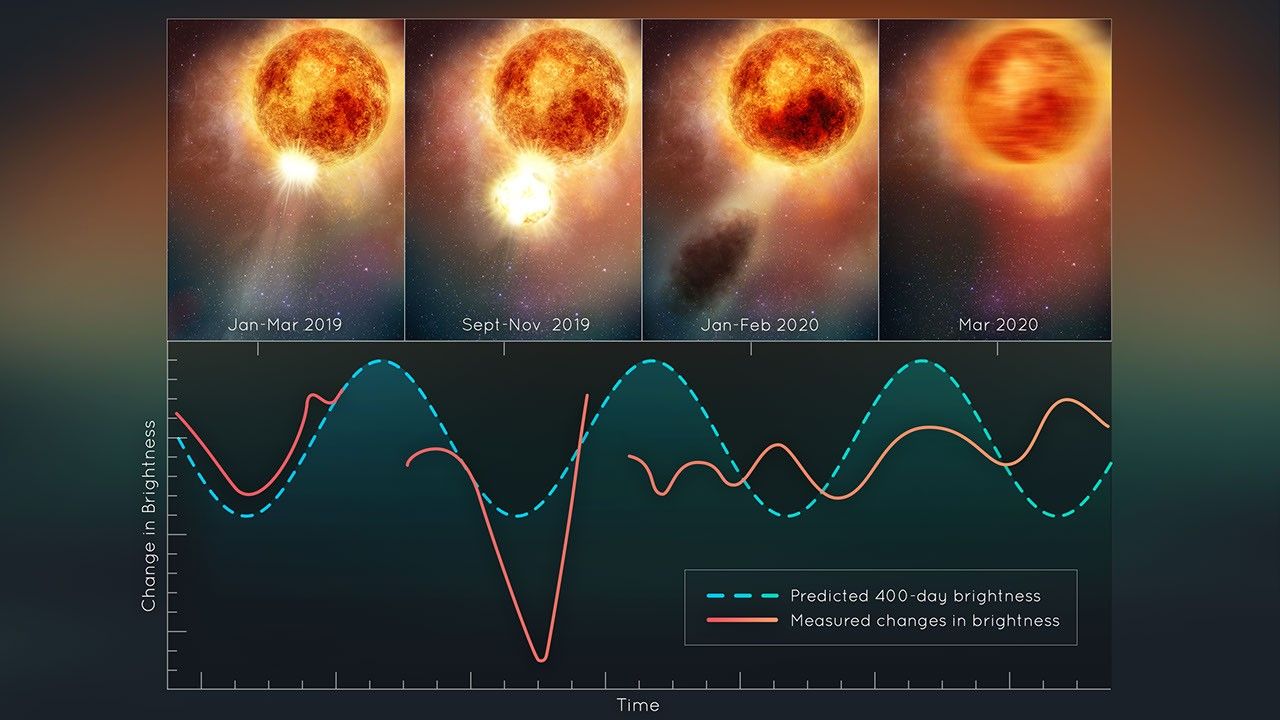
Betelgeuse dimmed dramatically in 2019 and 2020, an event some early theories attributed to a companion passing in front of it, though later research pointed instead to a giant cloud of stellar dust the star had shed. The new image doesn't resolve that older mystery, but it does confirm, directly, for the first time, that the star some skywatchers have nicknamed a ticking bomb has never truly been alone.