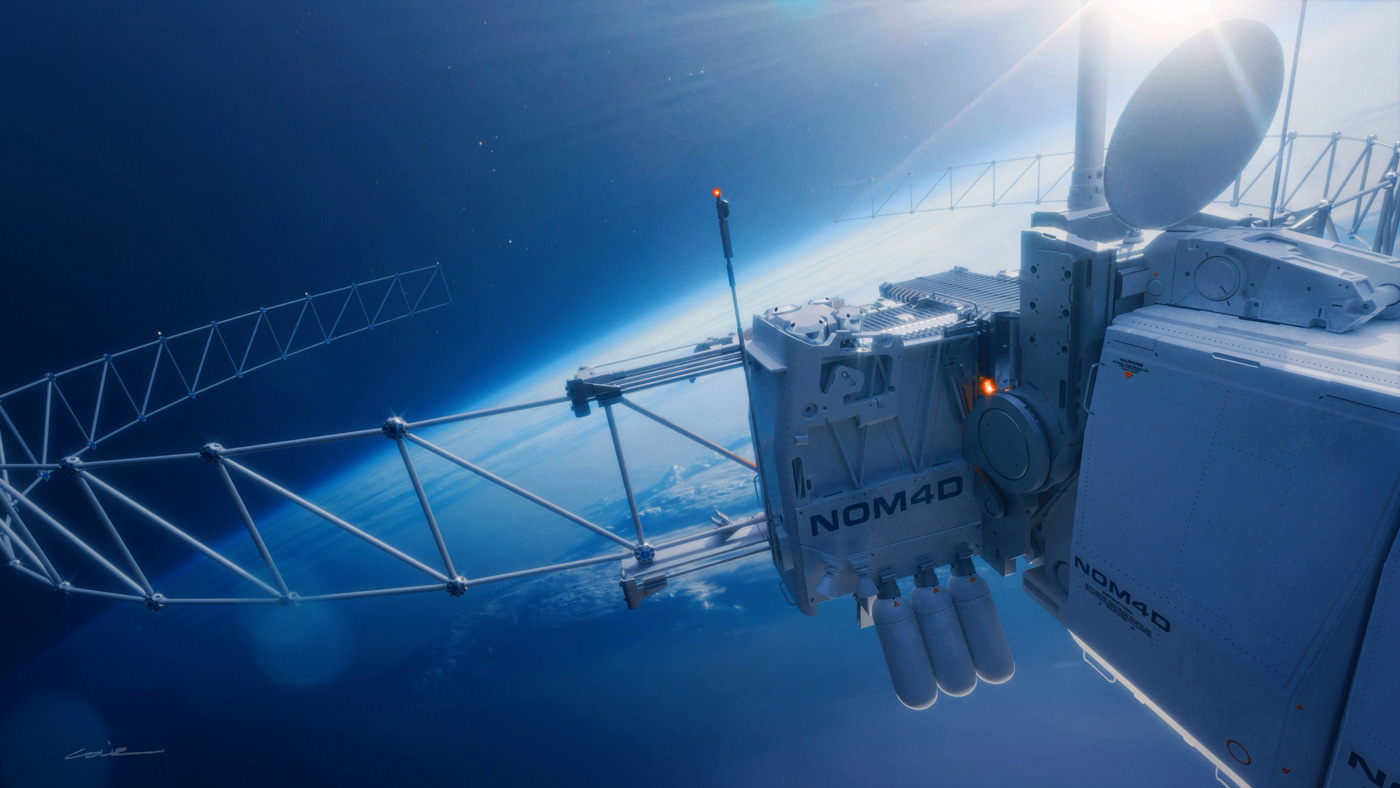
A small robot operating in orbit has become the first machine to autonomously assemble part of a structure while already in space, according to the Defense Advanced Research Projects Agency, which funded the demonstration through its Novel Orbital and Moon Manufacturing, Materials and Mass-efficient Design program, known as NOM4D.
The payload, built by engineers at the California Institute of Technology and launched in March aboard a SpaceX Transporter-16 rideshare mission on a Momentus Vigoride-7 platform, carries a simple gantry robot that travels along three linear axes. Working without a human at the controls, it has been pulling composite struts and aluminum joints from onboard dispensers, locking them together and unspooling a thin reflective mesh behind the growing frame.
"This is the first time that a structure has been autonomously constructed in space," said Sergio Pellegrino, the Caltech aerospace professor who leads the project, called ASTRA.
A test antenna frame, not a space station
The target structure is modest by design: a circular truss roughly 1.4 meters across, meant to mimic the skeleton of a satellite antenna reflector. ASTRA launched with two of its three sections pre-built; the robot's job was to assemble the third from raw parts after reaching orbit, proving a machine can finish construction off Earth rather than requiring every piece built on the ground first.
Caltech does not expect the frame to be finished before the mission ends in December, after the robot hit unanticipated snags during assembly, according to a report on the demonstration. Engineers kept an identical copy of the hardware on the ground, which let them reproduce each glitch and test fixes before sending up new instructions — a reminder that "autonomous" construction in orbit still leans heavily on a human team back on Earth.
DARPA program manager Andrew Detor said the project moved "from the idea of an on-orbit demo to launching a working prototype into space in 15 months," a turnaround pace the agency is pushing across its space-manufacturing portfolio.
NOM4D began in 2022 around a simple premise: instead of launching large, pre-built structures that must fit inside a rocket's fairing, ship up raw material and let robots build antennas, mirrors or solar arrays larger than any single launch could carry. A separate NOM4D-funded team at the University of Illinois Urbana-Champaign is expected to send a related in-space assembly demonstration to the International Space Station later this year, widening the test of autonomous construction beyond Caltech's design.